
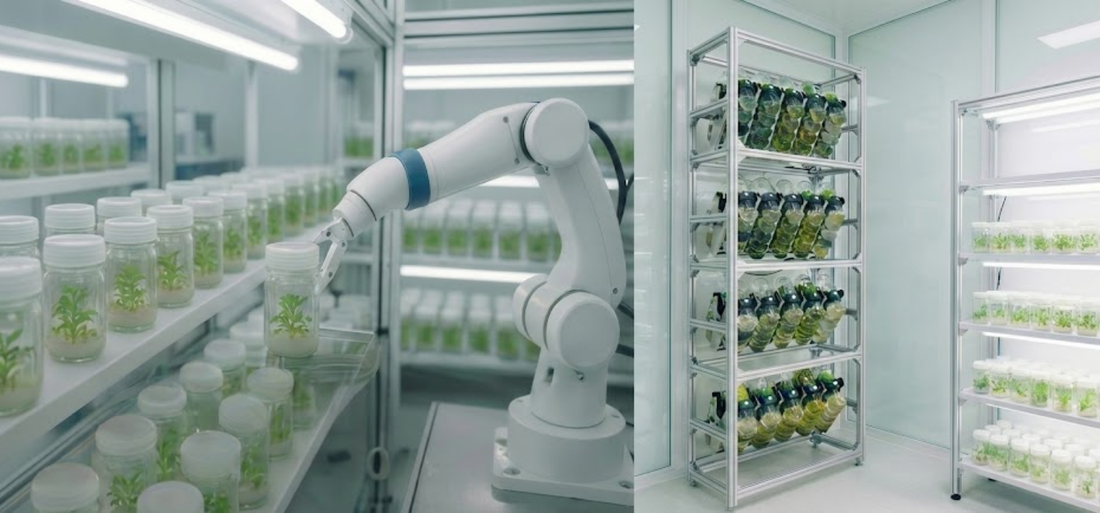
Why Labor is Modern Tissue Culture’s Greatest Challenge


Introduction
If you look at the numbers, the plant tissue culture industry is on a meteoric rise.
We are looking at a market valuation that is expected to hit over $1.3 billion by 2035.
On paper, it’s a biotechnological success story—we can take a single piece of a high-value plant and turn it into thousands of identical, disease-free clones in a sterile lab.
But if you talk to the people actually running these labs, you’ll hear a much more stressful story. Despite our sophisticated biological protocols, the way we physically move plants from one jar to another hasn't changed much in decades.
This brings us to a critical question: Can a 21st-century biotech industry survive on a 20th-century manual labor model?
Currently, in high-cost industrialized nations, labor accounts for a staggering 80% to 90% of total production expenses.
Even in regions where wages are lower, you’re still looking at 50% to 70%. We are hitting a "profitability ceiling" where the cost of the human hand is starting to outweigh the value of the plant.
To understand how we fix this, we have to look at the science of why plants are so difficult to handle and how automation is finally stepping in to bridge the gap.

Stage II Multiplication: The Hidden Profit Killer in PTC Operations
To understand the labor crisis, we have to look at the micropropagation workflow. It is generally divided into four stages, but Stage II—the Multiplication Stage—is where the budget usually breaks.
In Stage II, the goal is to take an established plantlet and get it to produce multiple shoots.
This is done by manipulating the ratio of plant hormones, specifically cytokinins and auxins, in the growth media. In a traditional setup using agar (a jelly-like substance), every single plant must be handled by a technician every four to six weeks.
A human has to sit at a sterile bench, use a scalpel to excise individual shoots or nodes, and then carefully place those new pieces into fresh media.
This is not just repetitive; it’s mentally taxing.
Plants are biological entities with variable growth patterns. They aren't standardized parts. A technician has to make a split-second decision on every single cut: Where is the meristematic tissue? How do I cut this to maximize the next cycle’s yield without killing the plant?
Because of this, there is a linear relationship between your output and your labor. If you want to double your production, you essentially have to double your workforce. You don’t get the "economies of scale" that you see in other manufacturing sectors.
Furthermore, humans are the primary vector for contamination. Even with the best aseptic techniques, human error leads to microbial losses that can hit 25% of your total production.
When you factor in rising wages and the shortage of skilled lab tech personnel, the manual agar model starts to look like a financial dead end for anything other than ultra-high-value niche crops.
How TIS Liquid Media is Replacing the Traditional Agar Cycle
One of the most effective scientific answers to the labor problem isn't a robot, but a change in the physical state of the nutrients. We are moving away from solid agar toward liquid media through Temporary Immersion Systems (TIS).
Why liquid?
In a solid agar setup, the plant only gets nutrients through its base.
In a liquid system, the entire surface of the plant can absorb nutrients and hormones. However, you can’t just leave a plant submerged in liquid; it will suffocate or develop a physiological disorder called hyperhydricity (where the plant becomes brittle and water-soaked).
TIS solves this by using air pressure or mechanical tipping to "bathe" the plants in liquid media for just a few minutes every several hours. This creates a few specific biological advantages:
-
Total Nutrient Uptake: The entire plant is coated in nutrients, leading to much higher biomass increases. For example, teak plants have seen a 10x biomass increase in TIS compared to agar.
-
Gas Exchange: Each time the media moves, it flushes out harmful gases like ethylene and replenishes oxygen.
-
Reduced Handling: Because the media is delivered automatically through a system of tubes and chambers, the need for a human to manually "subculture" the plants is drastically reduced.
In studies of crops like the Pennisetum grass, switching to TIS reduced labor’s contribution to variable costs from 43% down to 24%. By using BioCouplers™ with the BioTilt™ system, which can hold 50 to 100 plantlets at once, we move from "one-by-one" handling to "batch" processing.

From Manual to Bio-Digital: The Robotics and AI Lab Revolution
The final frontier of tissue culture is the physical handling—the cutting and moving. For a long time, we thought robots couldn't do this because plants are too "random" for a machine to understand. But the convergence of 3D image recognition and AI has changed that.
Systems like the RoBoCut represent a total shift in philosophy. Instead of a human with a scalpel, these units use AI-controlled vision to identify the morphology of a plantlet.
The system decides where the optimal cut points are, and then uses a laser to dissect the tissue. The laser is a scientific double-win: it’s incredibly precise, and it automatically sterilizes the cut surface as it goes, reducing failure rates from 10% down to 5%.
Bock Bio Science, which developed the system, suggests that the cost per plantlet in this setup is about one-third of manual culture.
Then there is the "semi-automation" route, like the NuPlant SmartClone system. This recognizes that human judgment is still elite. In this model, a human makes the critical decision on where to cut, but a robot handles all the "dumb" tasks: opening the boxes, presenting the plant, and moving the finished explants to new containers. This can increase a single operator’s throughput by up to 20 times.
Supporting all of this is the "intelligence layer." Labs are now using Convolutional Neural Networks (CNNs) to grade plant health in real-time.
These AI models can reach up to 99% accuracy in detecting early signs of disease or stress that a human eye might miss during an eight-hour shift.
This allows labs to practice "management by exception"—technicians only spend time on the vessels that the AI flags as having a problem, rather than inspecting every single jar in the incubator.
The Economic Reality: ROI and Reshoring
The big hurdle for automation is, of course, the initial cost.
Moving from a manual lab to an automated one is a shift from OpEx (wages) to CapEx (machinery). While a basic manual setup might cost $10,000 to start, a fully automated robotic line can run into the hundreds of thousands.
However, the Return on Investment (ROI) is becoming impossible to ignore. For most automated systems, the break-even point is reached within 6 to 18 months.
Why so fast?
Because an automated lab can run 24/7, doesn't require "training time" for new hires, and doesn't get tired. It also allows for much higher production density.
You can produce five times more plants in the same physical footprint because you don't need the vast amount of bench space required for dozens of technicians.
This is also leading to a global shift in where plants are grown. Historically, the high cost of labor in North America and Europe forced production to move to regions with lower wages. But automation is "reshoring" the industry.
When labor is only 20% of your cost instead of 90%, it makes more financial sense to produce plants closer to the final market, reducing shipping costs and the physiological stress that plants endure during long-distance travel.

Bringing It All Together
The tissue culture industry is currently a victim of its own success. The demand for disease-free, high-quality plants is higher than it has ever been, but the old way of doing things simply cannot scale to meet the need.
Labor isn't just an expense anymore; it’s a bottleneck that prevents us from securing our global food supply and horticultural future.
By embracing the science of liquid culture, the precision of lasers, and the "eyes" of AI, we can break that bottleneck. The lab of 2035 won't be a room full of people with scalpels; it will be an integrated bio-digital system where humans are elevated from repetitive manual labor to high-level scientific research.
Are you looking to optimize your laboratory’s performance and move beyond the limitations of manual protocols?
At Plant Cell Technology, we provide the specialized products and expert services designed to help you scale. Whether you are looking for advanced media formulations, contamination control solutions like PPM™, or consulting on how to transition your workflow toward more efficient, modern systems, we are here to help.
Visit Plant Cell Technology today to explore our full range of products and discover how we can help you turn biological potential into commercial profitability.
Blog Categories
View by Level
Popular Blogs

The Commercial Importance of Plant Tissue Culture
Summary Plant tissue culture is a multi-billion-dollar commercial engine for agribusiness and biopharma, enabling rapid, year-round micropropagation of uniform, true-to-type...
Read More
The Best Agar for Plant Tissue Culture
Summary Agar plays an important role in plant tissue culture, but choosing the right one can be confusing. This blog...
Read MoreFollow Us On Social


Follow Us On Social
Join the conversation
Your email address will not be published. Required fields are marked