

Preparing Murashige & Skoog (MS) Media: Step by Step Procedure


You must know, of all the media, the Murashige-Skoog (MS) medium is one of the most extensively used in plant tissue culture labs, worldwide. So, what is its recipe? What concentration of nutrients is required for the media?
Summary:
Murashige & Skoog media (also known as MS media) is one of the most commonly used media in the lab. Many of the time when you prepare media on your own in the lab, you need to measure a whole list of chemicals in the right micro concentrations. So, this blog provides you with all the details on its ingredients, concentrations, and how you can prepare the media for your tissue culture process.
Introduction
What's the hardest and most crucial part of in vitro culturing, or as you know, growing plants in labs?
Media preparation. Right?
It's so important to ensure that you are adding the right ingredients in the right concentration. And let's not forget there are too many chemicals on the list, and they need to be measured in micrograms. Here, accuracy is of the utmost importance.
Some of you might also be wondering what if we directly grow the plants in agar? It supports the plant, so why can't we do it?
The answer to the question is simple: plants need nutrients for their growth and survival, like all other organisms. In a natural environment, they fulfill their needs by getting them through the atmosphere and soil, and by associating with other organisms.
However, when plants are cultured inside the lab, they get nutrients and support for their proper growth and development through a medium. This can be any medium, like MS media (aka Murashige and Skoog medium), Linsmaier and Skoog (LS) medium, Gamborg (B5) medium, Nitsch and Nitsch (NN) medium, or any other customized media based on your plant species.
In the article “Tissue Culture Medium: Types and 5 Steps of Selection,” you can learn about the various types of media used to culture in vitro plants. You will also learn about the purposes served by different media, and how to select the right media for your plant in just 5 steps!
You must know that, of all the media, the Murashige-Skoog (MS) medium is one of the most commonly and extensively used media in plant tissue culture labs worldwide.
That's why, in this article, you will learn why MS media is commonly used, what the components of MS media are, and how the step by step process to prepare the media.
You will also find a handy chart at the end, which you can keep with you while preparing the media in your lab.
Major components of the MS media
The media involves the following four major components-/p>
-
Inorganic nutrient: It includes mineral salts that are important for the growth and development of the plants. It is categorized into two groups: Macronutrients (Calcium, magnesium, nitrogen) and micronutrients (copper, iron, and zinc).
-
Organic nutrient: It mainly includes vitamins and amino acids, required for the growth and differentiation of the cultures.
-
Growth hormones: It includes auxins, cytokinins, and gibberellins. It is essential for the growth and development of tissues and organs.
-
Gelling agents: It includes agar and gelatin. It provides support to the cultures for their establishment.
You can refer to the article “Major Components of Tissue Culture Media” to read more about the components of the media.
Media Preparation
Preparation of stock
1. Macronutrient Stock Solution (100×)
Procedure
- Add 400 mL double-distilled water to a 1 L beaker.
- Store the stock solution at 4°C.
- Use 10 mL of this stock solution to prepare 1 L of MS medium.

2. Micronutrient Stock (100X)
- Take 400 mL of double-distilled water in a 1 L beaker.
- Dissolve all salts completely.
- Transfer to a 1 L volumetric flask and make up the volume to 1 L.
- Use 10 mL of this stock solution for 1 L of MS medium

3. Iron Stock (20x)
- Take 80 ml of double-distilled water in a 100 ml beaker, weigh the components given in the table, and dissolve them completely (in the same order as given in the table).
- Transfer the solution to a volumetric flask of 100 ml and make up to 100 mL.
- Store at 4°C.
- Use 5 mL of this stock solution to prepare 1 L of MS medium.

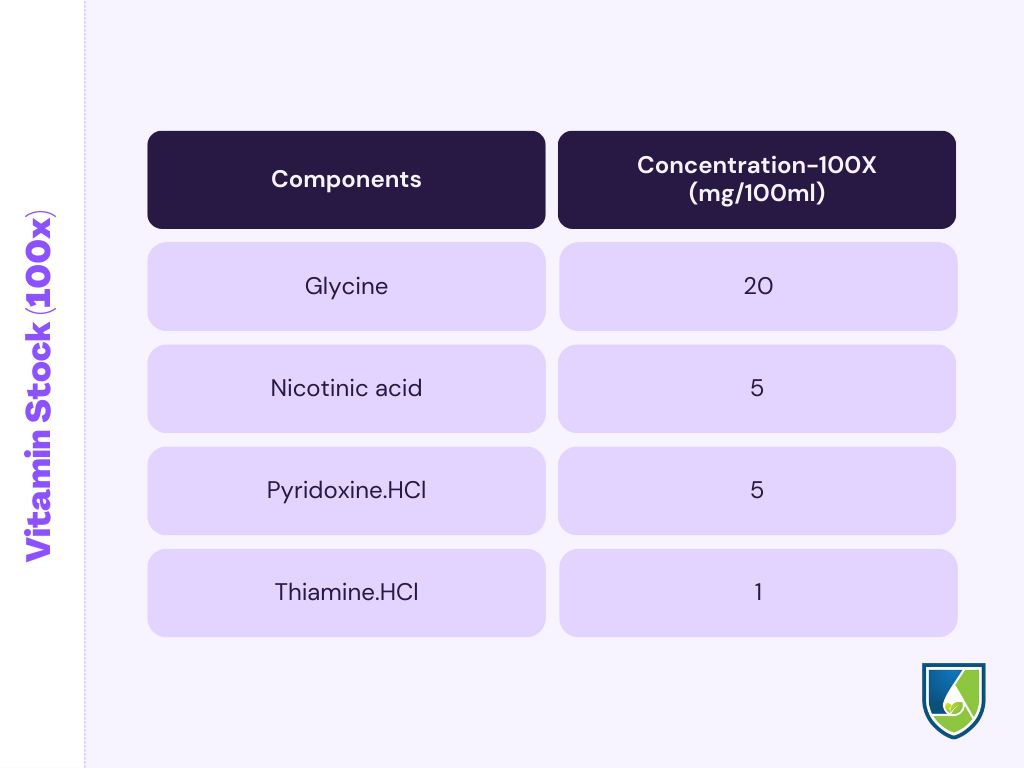
4. Vitamin Stock (100x)
- Take a 100 ml beaker and add 50 ml double-distilled water to it. Weigh the vitamins given in the table below and dissolve them completely in the water.
- Transfer the solution to a 100 mL volumetric flask and make up the volume to 100 mL.
- Store at 4°C.
- Use 1 mL of this stock solution to prepare 1 L of MS medium.
Note: For better stability, the vitamin stock may be filter sterilized (0.22 µm) and added after autoclaving when the medium cools to 45–50°C.
NOTE: Discard the vitamin solution after 30 days.
5. Plant Growth Regulators (Optional)
Plant growth regulators (PGRs) are not part of the standard basal MS medium. They are added depending on the plant species, explant type, and tissue culture objective, such as shoot multiplication, rooting, callus induction, or somatic embryogenesis.
Commonly used PGRs include:
-
Cytokinins: BAP, Kinetin, TDZ
-
Auxins: IAA, IBA, NAA, 2,4-D
-
Gibberellins: GA₃ (used less frequently)
Most PGRs are prepared as separate stock solutions and added at the required concentration according to the culture protocol.
Steps for Preparation of 1L MS Medium
Step 1: Add Water
Take 700–800 mL of double-distilled water in a 1 L beaker.
Step 2: Add Stock Solutions
Add the following stock solutions:
- 10 mL macronutrient stock (100×)
- 10 mL micronutrient stock (100×)
- 5 mL iron stock (20×)
- 1 mL vitamin stock (100×)
- 1 mL kinetin stock (100×) (if required)
Mix thoroughly.
Step 3: Add Myo-inositol
Add 100 mg myo-inositol and dissolve completely.
Step 4: Add Sucrose
Add 30 g sucrose and dissolve completely.
Step 5: Adjust pH
Adjust the pH of the medium to 5.7–5.8 using 1 N NaOH or 1 N HCl.
Step 6: Make Up the Volume
Transfer the solution to a 1 L volumetric flask and make up the final volume to 1 L with double-distilled water.
Final Steps
-
Sterilize all equipment, glass culture jars, and other materials required for the tissue culture process.
-
Add supreme-grade agar (typically 7–8 g/L) and sucrose (30 g/L) to the prepared MS medium. Heat gently while stirring until the agar dissolves completely.
-
Dispense the medium into culture jars or bottles and seal them with autoclavable caps or aluminum foil.
-
Sterilize the prepared medium by autoclaving at 121°C and 15 psi for 15–20 minutes.
-
If using filter-sterilized vitamin solutions or heat-sensitive plant growth regulators, allow the medium to cool to 45–50°C, then add them aseptically and mix gently.
-
Allow the medium to cool and solidify completely. Store the prepared culture medium at 4°C until ready for use.
Your MS culture medium is now ready for plant tissue culture.
Table: Stock Solutions for Preparing Murashige and Skoog (MS) Medium
Note: Unless otherwise specified, concentrations are for 100× stock solutions (mg/L). Iron stock is prepared as a 20× stock (mg/100 mL), while vitamin stock is prepared as a 100× stock (mg/100 mL).
| Stock Solution | Component | Stock Concentration |
| Macronutrient (100×) | NH₄NO₃ | 165,000 mg/L |
| KNO₃ | 190,000 mg/L | |
| CaCl₂·2H₂O | 44,000 mg/L | |
| MgSO₄·7H₂O | 37,000 mg/L | |
| KH₂PO₄ | 17,000 mg/L | |
| Micronutrient (100×) | MnSO₄·4H₂O | 2,230 mg/L |
| ZnSO₄·4H₂O | 860 mg/L | |
| H₃BO₃ | 620 mg/L | |
| KI | 83 mg/L | |
| Na₂MoO₄·2H₂O | 25 mg/L | |
| CuSO₄·5H₂O | 2.5 mg/L | |
| CoCl₂·6H₂O | 2.5 mg/L | |
| Iron Stock (20×) | Na₂EDTA | 672 mg/100 mL |
| FeSO₄·7H₂O | 556 mg/100 mL | |
| Vitamin Stock (100×) | Glycine | 20 mg/100 mL |
| Nicotinic acid | 5 mg/100 mL | |
| Pyridoxine-HCl | 5 mg/100 mL | |
| Thiamine-HCl | 1 mg/100 mL |
Stock Solutions Required for Preparing 1 L of MS Medium
| Stock Solution | Volume Required |
| Macronutrient stock (100×) | 10 mL |
| Micronutrient stock (100×) | 10 mL |
| Iron stock (20×) | 5 mL |
| Vitamin stock (100×) | 1 mL |
Additional Components Added to 1 L MS Medium
| Component | Amount |
| Myo-inositol | 100 mg |
| Sucrose | 30 g |
| Agar (or equivalent gelling agent) | 7–8 g |
| Plant Growth Regulators (Optional) | As required by the protocol |
| Final pH | 5.7–5.8 |
Save Yourself the Hassle with Ready-to-Use MS Media
Preparing MS medium from scratch is a great skill to learn, but let's be honest—it isn't always practical.
If you're a home tissue culturist, hobbyist, or even a busy lab, buying every chemical separately can be expensive and time-consuming. Then comes the measuring, mixing, pH adjustment, and sterilization. One small mistake in the formulation or concentration can affect your cultures and cost you weeks of work.
Instead of spending hours preparing media, you can simply start with ready-to-use MS medium and focus on what really matters—growing healthy plants.
At Plant Cell Technology, we offer high-quality pre-formulated MS media designed for plant tissue culture. Whether you're propagating orchids, houseplants, or rare species, our media helps you spend less time in preparation and more time culturing.
Browse our ready-to-use MS media and get started faster.
Looking for Media Formulated for Houseplants?
Not every plant responds the same way in tissue culture. While standard MS medium works well for many species, some houseplants perform better on media formulated specifically for their growth requirements.
If you're propagating Monstera, Philodendron, Pothos, Anthurium, Alocasia, or other popular houseplants, Plant Cell Technology's houseplant-specific tissue culture media to help simplify the process.

Which Type of Plants Can We Culture Using This Medium?
The medium has shown good results for various houseplant plants, such as:
- Philodendron
- Monstera
- Pothos (Epipremnum)
- Anthurium
- Syngonium
- Alocasia
- Calathea & Maranta
- Ficus species
- Begonia
- Other tropical ornamentals
Do you only need these two for the process?
Yes! For tissue culturing your favorite houseplants, you can simply use our Houseplant Multiplication & Rooting Medium.
If you plan to work with solid media, you’ll also need to purchase agar separately for gelling the media.
And if you want extra protection against contamination, we highly recommend adding PPM™ to your setup. It helps protect cultures from common bacterial and fungal contaminants and can be a valuable addition to your tissue culture arsenal.
How Much Media Do I Need To Prepare One Liter of Medium?
Houseplant Multiplication Medium (HPP01)
Preparation (per 1 liter):
- Measure 35.27g of HPP01 powder.
- Add to ~800 mL of distilled or deionized water.
- Stir until fully dissolved.
- Adjust final volume to 1 liter with distilled water.
- If preparing solid media, add your preferred gelling agent.
- Dispense into culture vessels.
- Sterilize by autoclaving at 121°C for 15–20 minutes.
Houseplant Rooting Medium (HPP02)
Preparation (per 1 liter):
- Measure 33.25 g of HPP02 powder.
- Add to ~800 mL of distilled or deionized water.
- Stir until fully dissolved.
- Bring the final volume to 1 liter with distilled water.
- If preparing solid media, add your preferred gelling agent.
- Dispense into culture vessels.
- Sterilize by autoclaving at 121°C for 15–20 minutes.
Notes:
- pH adjustment is not required (pre-buffered), but verifying pH is recommended.
- No additional inputs or supplements needed.
- Can be used in liquid or solid systems.
Explore our collection to find the right medium for your favorite plants and spend more time growing—not mixing chemicals.
Blog Categories
View by Level
Popular Blogs

5 Reasons You May Be Failing at Plant Tissue Culture
Summary Plant tissue culture can help you produce large numbers of healthy plants in a controlled environment, but success depends...
Read More
What Makes a Plant a Great Tissue Culture Model?
Introduction If you have ever worked in a plant biotechnology lab, you know that plant tissue culture can feel as...
Read MoreFollow Us On Social


Follow Us On Social
Join the conversation
Your email address will not be published. Required fields are marked